USB Audio DAQ Card 384 kHz - 32 Bit - 24 Bit ADC - IEPE DAQ 120 kHz
Galvanic Isolated Analog Input
Switchable IEPE sensor power supply
A USB audio interface ( DAQ = data acquisition) card is an external device that connects analog audio sensors or instruments to a computer. It processes physical signals using an analog-to-digital converter (ADC) and transmits the data natively via a standard USB audio protocol.
These cards are valued by acousticians, sound engineers, and hobbyists alike for their driverless, plug-and-play integration. Because they are recognized as standard USB audio interfaces, they are highly compatible with programming environments and recording software such as MATLAB, LabVIEW, and Audacity.
Key specifications and features include: High resolution—many specialized cards offer 24- to 32-bit resolution and extremely high sampling rates of up to 384 kHz to capture highly detailed acoustic and vibration data.
IEPE/ICP support—high-quality measurement cards (such as the RogaDAQ 384 or RogaDAQ2 from ROGA-Instruments) feature integrated IEPE (Integrated Electronics Piezo-Electric) support. This allows for the direct powering of specialized measurement microphones and accelerometers without the need for a separate signal conditioning unit.
DC coupling—unlike conventional consumer-grade USB DACs, professional audio DAQ cards offer true DC coupling. This enables the measurement of static signals or extremely low-frequency signals (often down to 0.3 Hz), making them ideal for seismic analysis and infrasound monitoring.
Noise reduction—specialized USB audio cards are sometimes used by audiophiles to minimize ground loops or interference pickup; however, galvanic isolators are generally considered the more cost-effective solution within the “r/audiophile” Reddit community.
Inexpensive USB sound cards can be used for general audio data acquisition. However, for specialized vibration and acoustic analysis, dedicated measurement devices—such as the RogaDAQ 384 from ROGA-Instruments—are the standard.
RogaDAQ 384

- RogaDAQ 384 Datasheet coming soon
Galvanic Isolated Analog Input | 2ch single ended BNC, IEPE, AC, DC |
|---|---|
Simultaneously sampling ADCs | 2 |
ADC Resolution | 32, 24, 16 Bit selectable |
Sampling rate | 384 kHz |
Range input on request | ±10 Volt ±5 Volt, ±1 Volt |
AC- or DC-coupling | Selectable |
IEPE sensor supply | 4.3 mA – 23 Volt |
Anti-Aliasing filter | Self adjusting |
Accuracy | better ± 0,1 dB |
Dynamic Range | 133 dB (FFT-based) with IEPE Supply |
THD | < 0.0016 % |
Frequency Response | DC – 120 kHz (± 0,3 dB)
|
With IEPE Supply |
0.3 – 120 kHz (± 0,3 dB) |
Powered via USB C Port | Power consumption < 4 W |
Temperature range | 0 to + 50 °C |
Dimensions | 112 (w) x 178 (d) x 45 (h) mm |
Weight | 400 g |
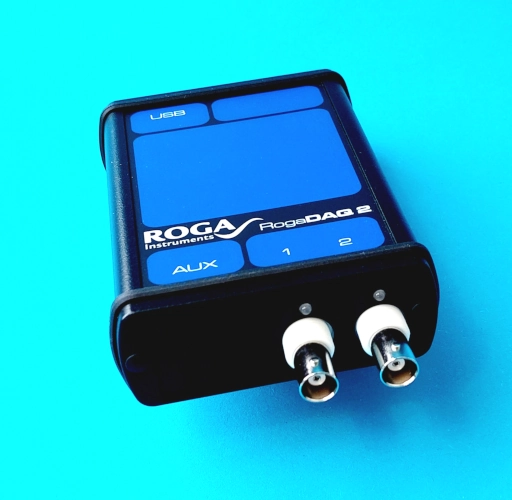
The RogaDAQ2 measurement card is a compact 2-channel IEPE sensor DAQ for recording and analysis.
It features a widely used USB interface, eliminating the need for additional driver installation. In addition to AC/DC inputs, the device can directly support IEPE sensors, such as microphones, accelerometers, and impact hammers.
Various input ranges of 10 V, 5 V, or 30 V allow for optimal adjustment of the sensor signal-to-noise ratio.
Other measurement range combinations are available upon request.
Anti-aliasing filters are automatically configured to ensure data integrity for sound and vibration analysis.
A bandwidth of DC to 24 kHz per channel and simultaneous sampling make the RogaDAQ2 extremely flexible and compatible with all software packages that support USB audio devices.
Measurement programs such as Matlab, Audacity, DASYLab, LabVIEW, RogaREC, and NVH Analyzer Pro operate directly in real time.
It is particularly well-suited for infrasound and seismic measurements from 0.3 Hz upwards with all IEPE sensors.
Analog Input | 2ch single ended BNC, IEPE, AC, DC |
|---|---|
Simultaneously sampling ADCs | 2 |
ADC Resolution | 24 Bit |
Sampling rate | 48 kHz |
Range input on request | ±10 Volt ±30 Volt |
AC- or DC-coupling | Selectable |
IEPE sensor supply | 4 mA – 24 Volt |
Anti-Aliasing filter | Self adjusting |
Accuracy | better ± 0,1 dB |
Dynamic Range | 124 dB(FFT-based) |
THD | < 0,005%, |
Frequency Response | DC – 24 kHz (± 0,05 dB)
|
With IEPE Supply |
0.3 – 24 kHz (± 0,05 dB) |
Powered by USB Port | Power consumption < 1W |
Temperature range | 0 to + 50 °C |
Dimensions | 85 (w) x 132 (d) x 35 (h) mm |
Weight | 230 g |
Supported operating systems: Windows
Software Compatibility: ARTA – Audacity – DASYLab – imc WAVE – LabVIEW – MATLAB – ME’Scope – NVH-IMP – NVH-FFT – Visual Analyzer – WavePad Sound Editor – Sigview – Soundcard Oscilloscope – SO Analyzer – SpectraPLUS-RT – SpectraPLUS-SC – Multi-Instrument
AC-, DC- and IEPE On / Off via Windows Sound Mixer RogaDAQ2 Setting.
Here you will find operating instructions for activating the AC/DC coupling and the IEPE sensor supply independently of the channel.
Vibration monitoring with
RogaDAQ2 NVH-MON KIT
Areas of application
- Machine and plant engineering
- Production lines & manufacturing
- Pumps, motors, bearings & gearboxes
- Pilot projects for the introduction of predictive maintenance
RogaDAQ2 AC/DC Coupling Setting
Low frequency measurement with seismic IEPE accelerometer
The RogaDAQ2 USB DAQ was designed for use in sound and vibration measurement technology.
You can control two analog inputs independently to turn the IEPE supply on or off.
For instance, you could connect a seismic IEPE accelerometer to channel 1 and a DC-coupled magnetic field sensor to channel 2 to figure out the best setup for an MRI system.