Skip to content

Free FFT analysis software with a 384 kHz USB audio DAC

A USB audio DAQ (data acquisition) card is an external device that connects analog audio sensors or instruments to a computer. It processes physical signals using an analog-to-digital converter (ADC) and transmits the data natively via a standard USB audio protocol. 

These cards are valued by acousticians, sound engineers, and hobbyists alike for their driverless, plug-and-play integration. Because they are recognized as standard USB audio interfaces, they are highly compatible with programming environments and recording software such as MATLAB, LabVIEW, and Audacity. 

Key specifications and features include: High resolution—many specialized cards offer 24- to 32-bit resolution and extremely high sampling rates of up to 384 kHz to capture highly detailed acoustic and vibration data. 

IEPE/ICP support—high-quality measurement cards (such as the RogaDAQ 384 or RogaDAQ2 from ROGA-Instruments) feature integrated IEPE (Integrated Electronics Piezo-Electric) support. This allows for the direct powering of specialized measurement microphones and accelerometers without the need for a separate signal conditioning unit. 

DC coupling—unlike conventional consumer-grade USB DACs, professional audio DAQ cards offer true DC coupling. This enables the measurement of static signals or extremely low-frequency signals (often down to 0.3 Hz), making them ideal for seismic analysis and infrasound monitoring. 

Noise reduction—specialized USB audio cards are sometimes used by audiophiles to minimize ground loops or interference pickup; however, galvanic isolators are generally considered the more cost-effective solution within the “r/audiophile” Reddit community. 

Inexpensive USB sound cards can be used for general audio data acquisition. However, for specialized vibration and acoustic analysis, dedicated measurement devices—such as the RogaDAQ 384 from ROGA-Instruments—are the standard.

Visual Analyser is a comprehensive, professional real-time software suite that transforms your PC into a complete set of measuring instruments.

It requires no additional hardware (as it utilizes the PC’s sound card), yet it also supports the use of specialized external hardware (examples of which can be found in the following section). Visual Analyser runs on the Windows operating system; the “Visual Analyser 26 Silvia” edition is currently available (supporting both 64-bit and 32-bit versions).

Thanks to the “Wine” utility, VA can also be run on Linux. Features for managing WAV, MP3, and FLAC files were introduced in the 2012 version and further refined in the 25 series. VA is freeware.

Hum - Infrasound Measurement with USB Microphone

In this presentation, I will show you how to measure hum and infrasound using a calibrated USB measurement microphone.
 
Data analysis is performed using the open-source software SCILab.
 
The script, user manual, and report template are provided free of charge by engineer Edwin Krasser.
The first class 1 WS2F-compliant infrasonic measurement microphone with USB interface on the market.
 
It is equipped with a pre-polarized 1/2” microphone capsule that has been specially developed for low-frequency applications and works in a linear range from 1 Hz to 20 kHz.
 
The iSV1611 USB microphone preamplifier is able to perform measurements in two different level ranges simultaneously.
 
The measurement of infrasound is possible with very low ambient noise from a level of 15 dBA.
 
The USB microphone preamplifier is designed for three different sampling rates: 48 kHz, 96 kHz and 192 kHz.
 
This allows the iSV1611 digital preamplifier to be combined with other microphone capsules, e.g. for ultrasound or high-level measurements.
 

FFT Analyser Software - FRF - EMA - ODS - NVH Analyzer Software for R&D
Features

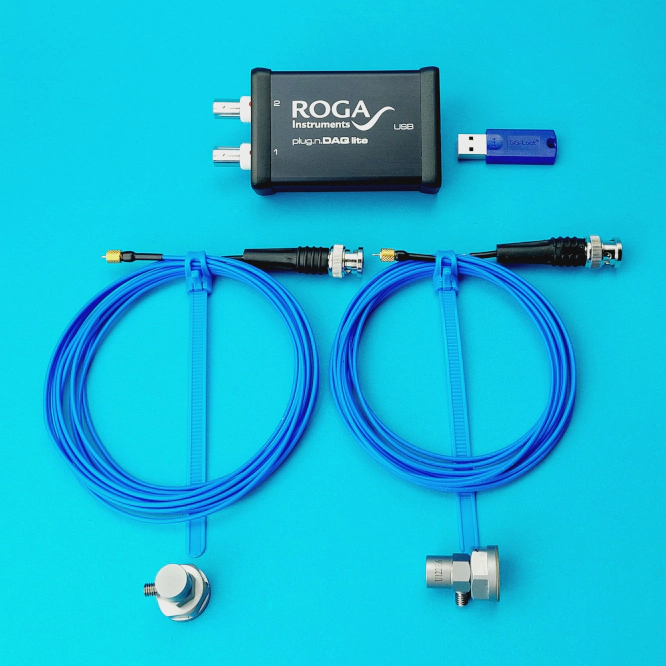
● 1 x 2 channel IEPE Interface USB DAQ
● 2 x Accelerometers, 50 g measuring range
● 2 x 10-32 BNC sensor cables, 3 meters long
● 2 x Insulating magnetic mounts with 100 Nm holding force
● NVH-FFT vibration analyzer software

Applications

● General vibration measurement
● Machine monitoring
● Bearing damage early detection
● Impact hammer testing – Modal hammer measurement
● Measurement of vibration acceleration, displacement, and velocity

Analysis of the deflection shape during operation using an impulse hammer and recording of raw data
Operational Deflection Shape (ODS) analysis software can be used independently or in conjunction with other applications.
 
This software offers customizable workflows and integrates all the necessary features for ODS measurement and analysis, such as time, spectrum, and rise/fall phases.
 
This brief presentation illustrates the recording of data from nine IEPE accelerometers mounted on a steel plate.
 
The steel plate is subjected to excitation by an impact hammer to generate raw data for operational vibration analysis.
Free Measurement Data Acquisition Software - Measurement Data Recorder Software

RogaREC

The RogaREC software was developed for a wide variety of test and measurement devices, enabling the use of a front-end system such as a PC-based data recorder; RogaREC also works with any PC sound card.
 
RogaREC’s key feature is its ability to simulate a recorder, eliminating the need for a user manual.
 
RogaREC supports the analog input channels of various sound cards, including Plug.n.DAQ and RogaDAQ2.
 
The measurement bandwidth is specified in Hz or kHz, depending on the device.
The display allows switching between bar graph and oscilloscope views.
 
Channel overload indicators for each channel, pre and post triggers, and a recording time function complete the RogaREC product.
 
Channel data is saved in the TEAC TAFFmat file format, which is compatible with NVH Analyzer, FlexPro, DaDisp, DiaDem, ArtemiS, FAMOS, LMS, and other post-processing analysis products.