Skip to content

Low Noise IEPE Sensor Interface

IEPE microphone interface with measuring range from 13 dB(A) to 97 dB(A)

This IEPE measurement microphone USB interface was specially developed for high-quality condenser measurement microphones for measuring particularly low sound levels.

The inherent noise of the PnDL-100 is 13 dB(A) and the inherent noise of WS2F class 1 measurement microphones with 50 mV/Pa sensitivity is 15 dB(a) to 17 dB(A).

The PnDL-100 is ideal for noise measurements from 13 dB(A) to 97 dB(A).

Supported operating systems: Android – Linux – Windows – macOS

PnDL-100
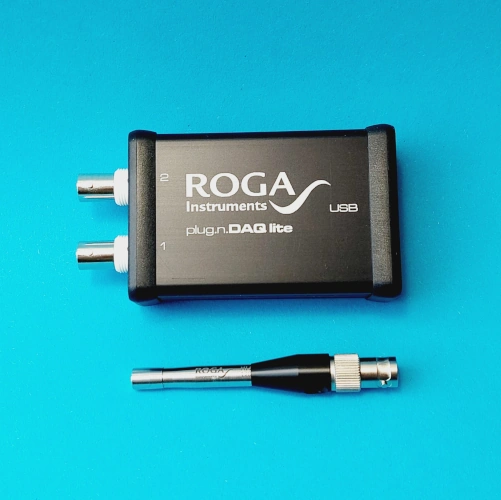
Linux DAQ Linux ADC Windows DAQ Windows ADC
Analog Input
2ch single ended BNC, IEPE
Inherent noise
13 dB(A) with 50 mV/Pa mic sensitivity
IEPE power fixed
21 Volt / 4mA
Fixed input range
0.1 V Volt Peak
Bandwidth
1 Hz to 24 kHz (-3dB)
10 Hz to 22 kHz (-0.5dB)
Sampling Frequency
48 kHz, – 44.1 kHz – 32 kHz – 22.05 kHz
16 kHz – 11.025 kHz
Absolute accuracy
1 % typical
Gain accuracy
0.2 % or better
Distortion
< 0.05%
Dynamic range
> 100 dB(FFT-based)
Pass band ripple
0.05 dB
Powered by USB Port
Power consumption < 1W
Temperature range
+/-0 to +50 °C
Dimensions
57 (w) x 104 (d) x 28 (h) mm
Weight
110 g

Supported operating systems: Android – Linux – Windows – macOS

Plug.n.DAQ Lite Software Compatibility: ARTA – Audacity – DASYLab – imc WAVE – LabVIEW – ME’Scope – NVH-IMP – NVH-FFT – Visual Analyzer – WavePad Sound Editor – Sigview – Soundcard Oscilloscope – SO Analyzer – SpectraPLUS-RT – SpectraPLUS-SC – Multi-Instrument

Sound and Vibration Analyzer DAQ - USB IEPE Sensor Data Acquisition
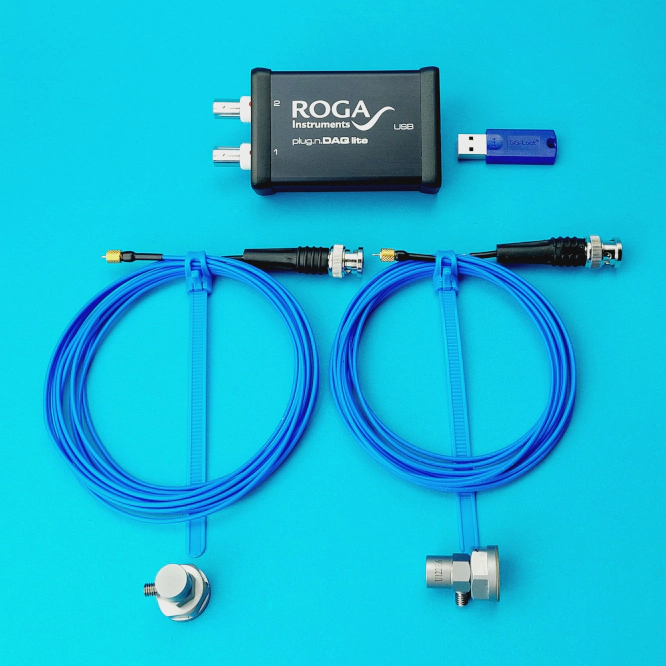
PnDL-VIB-SET  Vibration analyzer set with accelerometers and comprehensive vibration analysis software.
 
Our PnDL-VIB set comes complete with all components, from the IEPE sensor to the analysis software. It includes two IEPE accelerometers with magnetic mounting cables, a 2-channel IEPE USB DAQ, and comprehensive NVH analyzer software comprising the NVH-FFT and NVH-IMP modules.
 
The software’s hardware setup allows you to configure sensor sensitivities and their physical units, ensuring all results are displayed in units. The analyzer section allows you to adjust settings such as FFT line resolution, averaging, frequency band limiting filters, and presets for level-time weighting. Vibration acceleration, displacement, and velocity can also be measured. Adjustable averaging times can be further configured.
 
Acoustic weighting filters A, B, C, and Z with standard-compliant averaging times (slow, fast, and impulse) can also be preset. The visual output offers pre-configured graphic masks, for example, for impulse hammer measurements. Display windows with functions such as time signal, FFT, averaged FFT, 1/3 octave, level-time history, and orbit display can be configured there.
 
The calculated results of the individual windows can be exported in CSV format. The report generator function allows for the automation of graphic output. The recorder function enables parallel recording of the raw data. If required, the raw data can be exported in CSV format with unit scale.

Vibration Analysis Set

Vibration Analyzer

PnDL-VIB-SET

Features

● 2 x IEPE-channel USB DAQ sensors
● 2 x Accelerometers, 50 g measuring range
● 2 x 10-32 to BNC sensor cables, 3 meters long
● 2 x Insulating magnetic mounts with 100 Nm holding force
● NVH-FFT vibration analyzer software

Applications

● General vibration measurement
● Machine monitoring
● Bearing damage early detection
● Impact hammer testing – Modal hammer measurement
● Measurement of vibration acceleration, displacement, and velocity

Low noise IEPE microphone at 10 volt range input, sound pressure level and microphone sensitivity.

A typical 1/2″ measurement microphone delivers a voltage of 50 mV at 1 Pascal. 1 Pascal corresponds to a sound pressure level of 94 dB. 94 dB is already very unpleasant for humans and is only tolerated in rare situations.
 
During a normal conversation, the sound pressure level is below 74 dB, i.e., 20 dB lower. 20 dB quieter is a factor of 10 quieter.
 
This means that at 74 dB, the microphone only delivers 5 mV.
 
Assuming that end-of-line testing involves acoustically testing parts in a soundproof test chamber, it can be assumed that the measurement microphone delivers only a few microvolts.

94 dB = 50 mV
74 dB = 5 mV
54 dB = 500 µV
34 dB = 50 µV
14 dB = 5 µV

IEPE DAQ with low inherent noise
The choice of the input measurement range for the measurement data acquisition is therefore crucial. Assuming that the measurement card has a measurement range of 10,000 mV and the measurement microphone is exposed to a sound pressure level of 74 dB, which delivers 5 mV, the 10,000 mV measurement range is significantly too coarse for this application.
 
The difference becomes even more apparent when you consider that verbal interaction is reduced in the office. At a sound pressure level of 54 dB, the voltage detected by the measurement microphone is 0.5 mV.
 
The comparison scenario with a scale with a 10,000 kg measurement range illustrates that weighing a 0.5 kg object is associated with a high degree of inaccuracy.
 
Our solution for this application is the PnDL-100 with an input measurement range of 100 mV, which delivers an acoustic measurement range of 13 to 97 dB(A).