Infrasound Measurement
Detection of Airborne and Structure-Borne Sound Transmission with Low-Frequency Sensors
In this presentation, I will first show you how we test and evaluate a suitable USB measurement microphone for infrasound measurements using an iPhone.
The MEMS microphones built into all smartphones are optimized for speech intelligibility at frequencies of 80 Hz and above.
Low-frequency sound pressure levels—such as those caused by wind gusts—would impair microphone performance and degrade speech intelligibility.
Consequently, most microphone preamplifiers feature a high-pass filter set at 20 Hz.
This also applies to all USB audio interfaces with 48-volt phantom power.
Specialized measurement devices for industrial acoustics are capable of capturing infrasound starting at 1 Hz—or, when used with the RogaDAQ 384, even as low as 0.3 Hz.

Human Sound Perception and dB(A) Weighting of Sound Compared to Loudness in Sone
- Loudness Level phon vers time
- Loudness Level sone vers time
- Sharpness acum vers time
- Loudness Level phon vers speed
- Loudness Level sone vers speed
- Sharpness acum vers speed
- Specific Loudness
- Open Articulation index vers time
- Open Articulation index vers speed
Our product list of suitable systems for infrasound and structure-borne sound measurements
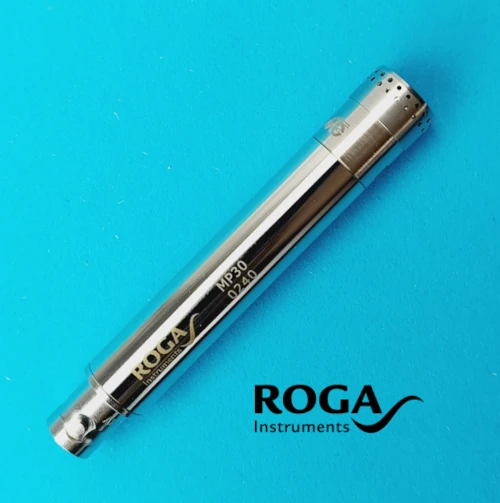
Class 1 – WS2F – DIN IEC 61094-4
- Sensitivity 50 mv/Pa
- IEPE constant current supply 2-20 mA
- Directional characteristic: omnidirectional
- Frequency response: 0.5 Hz – 20 kHz (± 2 dB)
- 0.5 Hz – 3.5 Hz: ± 2 dB
- 3.5 Hz – 4 kHz: ± 0.5 dB
- 4 kHz – 20 kHz: ± 2 dB
- Acoustic noise floor 15 dB A-weighted
- Measuring range 15 dB(A) to SPL peak (5% dist.) 135 dB
Structure-borne sound measurement in buildings
In this presentation, I will demonstrate how infrasound and low-frequency building vibrations can be measured using a seismic accelerometer.
The measured structure-borne sound source, with a frequency of 80 Hz * 60 seconds is a fan, with 4800 rpm, of a NAS located in the corner of a building.
Structural Dynamics Vibration Measurement System
Modal hammer – accelerometer
Sensor DAQ
NVH-IMP software for FRF measurement

Application areas include scientific research, industrial monitoring, and construction.
The modal hammer is connected to the first channel, and the accelerometer to the second channel, enabling structural investigations, for example, of bridge or building structures.
The measurement is performed using the NVH-IMP software, which is pre-configured for impact hammer test measurements with an FRF transfer function.
The sensor sensitivity of the modal hammer in N and the sensitivity of the accelerometer in m/s² are entered into the software before the test. The size of the sensors can vary depending on the object’s size and mass.
All important measurement results are displayed by the software. Double impacts are immediately visible.
Triaxial Seismic Accelerometer
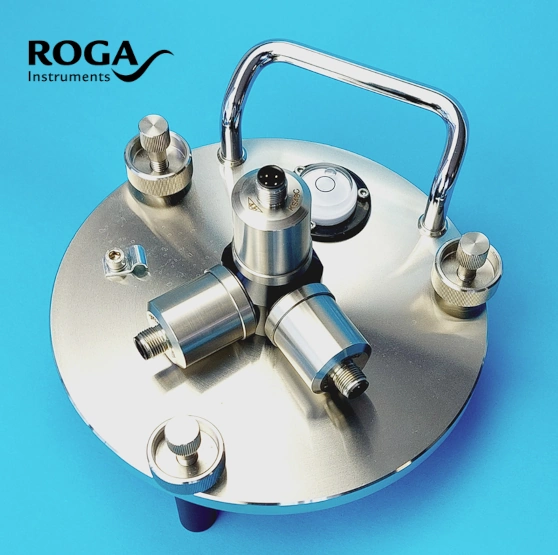
- 230 Triaxial mounting cube; M8; □34
- 729 Tripod floor plate to DIN 45669-2
- 3 * KS48C High Sensitivity Accelerometer 1000 mV/g
KS48C-3 + 729 Tripod floor plate Set
KS48C Specifications
- High Sensitivity Accelerometer
- Suitable for seismic measurements and structural investigations at low frequencies
- Highly sensitive sensor system without internal amplification thus excellent resolution and lowest noise
- Particularly good sensitivity/ mass ratio
- IEPE voltage output
- Frequency response 0.07 Hz – 4000 Hz (-3dB)
- Sensitivity 1000 mV/g
- Residual noise wide band; <14 µg RMS (0,5 – 10000 Hz)
- Mass 165 grams
- Measuring range ± 6 g
- Robust design with M12 connector
- Protection grade IP67
KB12VD/01 + 729 Tripod floor plate Set
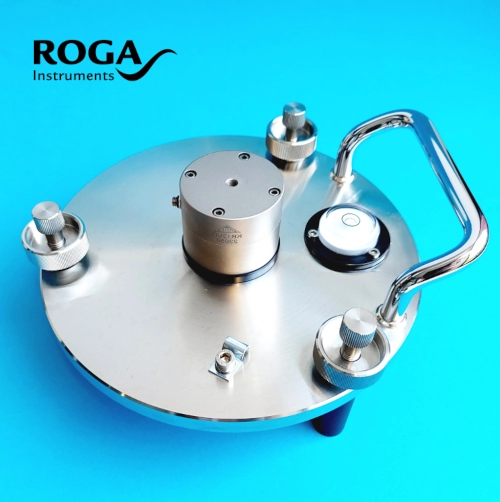
The seismic accelerometer set is designed to measure low-frequency vibrations. Its high sensitivity makes it ideal for a wide range of applications.
The highly sensitive accelerometer has a measuring range of 10 V/g, allowing it to detect even the smallest vibrations.
KB12VD Specifications
- High Sensitivity Accelerometer
- Suitable for seismic measurements and structural investigations at low frequencies
- Highly sensitive sensor system without internal amplification thus excellent resolution and lowest noise
- Particularly good sensitivity/ mass ratio
- Air-damped resonance and overload protection by friction coupling
- IEPE voltage output
- Frequency response 0.05 Hz – 260 Hz
- Sensitivity 10 000 mV/g
- Mass 150 grams
- Measuring range ± 0.6 g