Order Analysis – Tracking Filters
ROGA Instruments offers specialized measurement systems and software for psychoacoustics and sound design. These solutions combine precision sensors (e.g., microphones and accelerometers) with analysis software to evaluate noise not merely in purely physical terms (in decibels), but based on human perception.
Core Areas of ROGA Psychoacoustic Measurement Setups: The use of USB measurement microphones and sensors (primarily IEPE-based), which connect directly to a PC via Plug.n.DAQ systems.
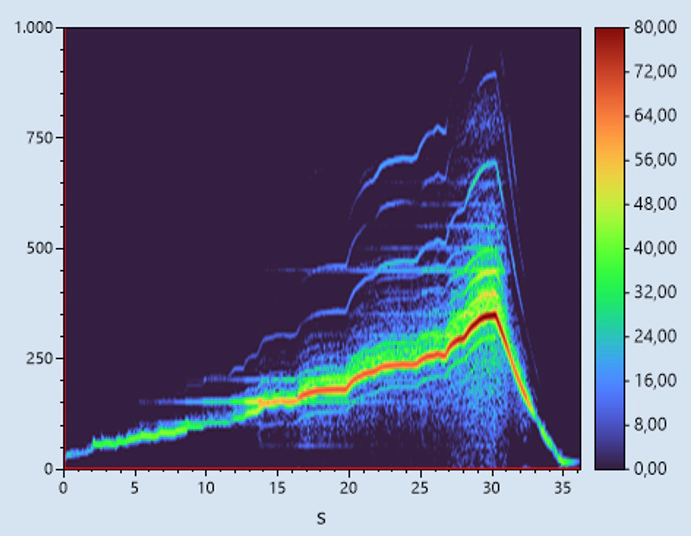
In this presentation, I demonstrate how you can use the NVH Analyzer software to perform vibration analyses on rotating machinery, gearboxes, and generators as a function of rotational speed. Subsequently, order analyses can be applied, and the filtered vibrations can be listened to as a function of rotational speed.
ORDER TRACKING | |
|---|---|
Frequency source | Counter: optical tacho, proximity, pick-up probe (1 pulse/rev), optical strip tape probe (with bl/wh tape, algorithm for determining number of pulses), 1-, 2-, 3- tracks encoder, gear tooth with missing teeth (e.g. 60-2), CDM, CDM with zero RPM channel: any analog speed channel, virtual (synthesized RPM channel, also in post-processing) Analog pulses: analog signal (e.g. 60-2) / analog tacho + angle sensor math |
Input Ch. for analysis | any analog input channel, e.g. IEPE accelerometer, microphone, etc… |
Visualization | 3D graph, Order and Frequency spectrum, Waterfall FFT real time extraction of single spectral lines of matrix Orbit plot, XY recorder, Bode plot, Nyquist plot of any order, any signal vs RPM |
Calculation criteria | Runup / Coast down / Both directions with RPM limits and Delta RPM and/or Delta Time |
Order FFT | from 8 to 256 orders, resolution from 1 to 1/64 |
Harmonics | extract overall RMS and amplitudes/phases/Real/Imag of selectable orders (from sub-orders e.g. 0.1x, 1x, 2x, 3x to max order) in Time domain & RPM domain |
Post processing | possible to add/change all calculations offline on the stored raw data |
Data export | Complex data (Real/Imag/Ampl/Phase) in any format, see Software Export section |
TORSIONAL VIBRATION | |
General | high precision rotational and torsional vibration and slippage measurement, by use of 2 rotary encoders |
Frequency source | optical strip tape probe (with bl/wh tape, algorithm for determining number of pulses), 1-, 2-, 3- tracks encoder, gear tooth with missing teeth (e.g. 60-2), CDM, CDM with zero |
Angle accuracy | up to 0,00075° at 10 000 rpm |
Angle resolution | up to 0,06° at 10 000 rpm |
Features | Rotational DC filter (0,1 to 10 Hz), compensation of uncentered encoder mounting |
Output | Rotational angle/velocity, Torsional angle/velocity |
Visualization | angle based view, time domain |
Heat Pump Noise – Psychoacoustics – Sound Design
Noise Levels in dB(A) vs. Loudness in Sone
Psychoacoustic Parameters: The analysis covers values such as loudness (in sones), sharpness, roughness, and tonality, among others.
These parameters capture the degree of human annoyance significantly more accurately than the standard A-weighted sound pressure level.
Industrial Applications: These systems are utilized to acoustically optimize machinery, devices (such as heat pumps), or components. The objective is to minimize intrusive noise and to develop products that are both more pleasant and quieter.
An illustrative practical example of the industrial application of psychoacoustic measurements and sound design:
In this presentation, I illustrate the difference between the standard A-weighted sound pressure level measurement and loudness expressed in sone.
This demonstration clearly demonstrates that A-weighting is an outdated measurement standard dating back to the 1930s—a standard that is highly industry-friendly and does not adequately reflect human auditory perception.
Meaningful Psychoacoustic SI Units:
- Loudness Level phon vers time
- Loudness Level sone vers time
- Sharpness acum vers time
- Loudness Level phon vers speed
- Loudness Level sone vers speed
- Sharpness acum vers speed
- Specific Loudness
- Open Articulation index vers time
- Open Articulation index vers speed
The shortcomings of the dB(A) weighting system were recognized as early as the 1970s, leading to the introduction of psychoacoustic SI units such as loudness (sone), bark, and sharpness.
Despite these findings, the industry continues to adhere to dB(A) weighting, as it offers numerous advantages for product marketing.
For instance, manufacturers of air-to-water heat pumps can easily comply with prescribed dB(A) limits, and the technical specifications provided by heat pump manufacturers typically refer to brand-new units.
The noise levels were determined in a laboratory, a test chamber, or an anechoic room.
This humming—or what is interpreted as infrasound—can manifest after just a few weeks. The cause is the uneven accumulation of dirt and particles on the fan blades, which leads to rotor imbalance. The resulting housing vibrations shift the entire system into a low-frequency range—far below 1 Hz.
The fluids contained within the heat exchanger can transmit these recurring vibrations to other areas.
Many remedial measures—such as flexible hoses or vibration dampers—can quickly lose their effectiveness in the event of minor changes to the mass or rotor speed.
Disturbing low-frequency droning, humming, or beating—such as is clearly audible in this YouTube video—is not captured by A-weighting; consequently, in this specific instance, dB(A) clearly does not serve the interests of those affected.
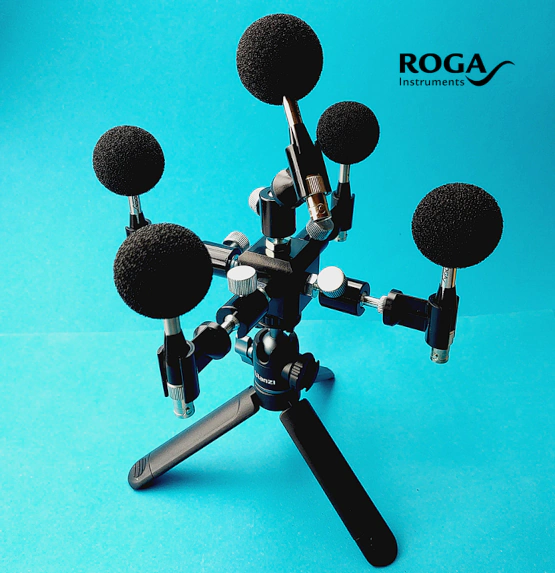
The Psychoacoustics Set:
consists of the following components: